Service Innovation
Design Concept
Cleanic
Designing trust into a subscription vehicle-care service
A service design case study for a pre-launch waterless vehicle cleaning subscription targeting tech park employees in Chennai.
Role: Service & UX Designer
Timeframe: Business design phase – 6+ months (SWOT, Porter's Five Forces, vendor & cost modeling); Service design phase – (3 months)
Status: Pre-launch – a design exploration on a live business plan, not an end-product
The Challenge
Cleanic looked like a straightforward convenience play: verified, uniformed 'Experts' cleaning vehicles on-site while users are at work. Most people I surveyed agreed – it's an easy yes.
But a closer read of the data surfaced a specific pocket of resistance hiding inside that majority: people already satisfied with how they clean their vehicle today, who still hesitated – not on price, but on letting someone else near their vehicle and their data. That's a segment a generic "book a wash" flow would quietly lose.
Problem Statement:
Cleanic’s business plan is unusually rigorous for a pre-launch venture, encompassing precise cost-per-clean modeling, facility-manager revenue-share frameworks, detailed staffing structures, and a competitive positioning strategy. However, this plan lacked a validated understanding of the prospective user.
While a robust unit-economics model determines financial viability, it cannot identify critical experience gaps:
Whether the sign-up process must establish trust before requesting payment.
Whether the deliberate "non-on-demand" service model will be perceived as inflexible by price-sensitive users.
Whether an ops assumption like fixed parking zones survives contact with how people actually park.
Process
Discovery
01
Research
Survey synthesis (21→27 responses) + business plan mining
Research
Stakeholder identification from staffing/ops sections
Empathy
Empathy maps — Priya, Divya, and Arjun
Empathy
Empathy maps — Priya, Divya, and Arjun
Research
Survey synthesis (21→27 responses) + business plan mining
Research
Stakeholder identification from staffing/ops sections
Empathy
Empathy maps — Priya, Divya, and Arjun
Empathy
Empathy maps — Priya, Divya, and Arjun
Define
02
Synthesis
3 core insights (trust ≠ price, control > tech, fixed-zone conflict)
Segmentation
3 behavioural personas, rebuilt when sample grew 21→27
SD Artifact
Current-state journey map
SD Artifact
Current-state journey map
Synthesis
3 core insights (trust ≠ price, control > tech, fixed-zone conflict)
Segmentation
3 behavioural personas, rebuilt when sample grew 21→27
SD Artifact
Current-state journey map
SD Artifact
Current-state journey map
Development: Ideation
03
Gap identified & closed
Five real alternatives generated and compared against criteria for the trust-barrier decision — trust-sequencing won on cost and feasibility
What exists now
An ideation comparison table, plus the future-state journey map showing the chosen direction
Development: Prototype
04
SD artifact
Service blueprint — user + Expert + Coordinator backstage
User flows (Subscriber)
Subscribe, pause, rate
User flows (Expert/Coordinator)
Shift, escalation, route assignment, low-rating flag, connectivity
Structure
Information architecture — user, Expert, Coordinator
SD artifact
Service blueprint — user + Expert + Coordinator backstage
User flows (Subscriber)
Subscribe, pause, rate
User flows (Expert/Coordinator)
Shift, escalation, route assignment, low-rating flag, connectivity
User flows (Expert/Coordinator)
Shift, escalation, route assignment, low-rating flag, connectivity
Service design supplied the why – stakeholder map, blueprint, both journey maps, none of which have a UX equivalent. UX design supplied the how – flows, IA, wireframes, visual system.
Research
Approach:
I ran a pilot survey in two batches, now totalling 27 respondents, screened to IT/ITES tech park commuters. Both are convenience samples rather than random ones – a standard limitation of this stage, not a flaw specific to either batch. This is a directional pilot, not representative data.
Insights from the data:
Trust is a moment-of-contact problem, not a marketing problem. "Verified Experts" as a label alone didn't fully resolve hesitation.
Safety & trust concerns
Price concerns
~2:1
Control matters more than tech. People wanted to pause or leave easily more than they wanted live tracking.
Flexible schedule
4.6
Easy cancel
4.5
App tracking
4.3
Photo proof
3.9
An ops assumption didn't survive contact with reality. Fixed parking zones assume a fixed spot – most respondents don't have one.
15 of 27
Stakeholder ecosystem
Cleanic isn't a two-sided app – it's B2B2C, with a facility manager as gatekeeper, an internal ops team most users never see, and an Expert as the one relationship with no digital layer in between.
Stakeholder map
Ecosystem map
Grouped by proximity to the daily service experience, not org-chart hierarchy.

Almost every stakeholder relationship runs through the app or through management – except the one where a stranger actually meets your vehicle. That's the throughline connecting research, personas, and the three user flows below into a single design problem worth solving deliberately.
Customer Experience
Key Findings
User Personas
Behavioral, not demographic – no age or income data, deliberately, since vehicles here cross every age bracket and income shouldn't gate a basic-tier service.

Priya, the skeptical loyalist (33%)
Satisfied with her own routine. The barrier is trust, not price.

Arjun, the ready convert (38%)
Largest segment, converts easily, but not barrier-free — several who say "yes" raise the same trust concerns as everyone else.

Divya, the conditional adopter (29%)
Open, but practical. Price and reliability decide her.
TODAY
Already satisfied with her own routine – self-cleans, or trusts a family member.
BARRIER
Trust, not price. Safety, quality, and data-privacy concerns dominate her hesitation.
DESIGN CUE
Show Expert verification and data controls before first use, not just proof after.
TODAY
Mixed — some already pay for an inconsistent service, others self-clean but are simply open to trying something better.
WHAT'S NEW
Now the largest segment, and less uniform than first thought: several who say "yes, definitely" still raise the same safety, quality, or reliability concerns as everyone else. Readiness and lingering concern aren't mutually exclusive.
DESIGN CUE
Don't skip trust-building just because this group converts easily — the same signals that win over Priya are what keep Arjun confident after signup, not just before it.
TODAY
Mixed habits, moderate satisfaction either way.
BARRIER
Practical, not emotional — package price, app reliability, signal quality.
DESIGN CUE
Entry-tier framing matters most here — Package 1, not Package 3, wins her over.
Current-state journey
Shared process stages, persona-specific emotion & pain · built from n=27 pilot survey

Both personas' emotion dips when a paid alternative first enters the picture – Priya sharply, on trust; Divya more gently, on price and reliability. That stage became the hinge for the future-state design.
Service Design Artifacts
Before designing the fix, I ran a real ideation pass – five alternatives compared against cost, feasibility, and business fit.

The winning move: sequencing, not a new feature. Trust-building – Expert verification, a free trial-first clean, now happens before the ask for subscription, not alongside it.
Future-state Journey & Service Blueprint
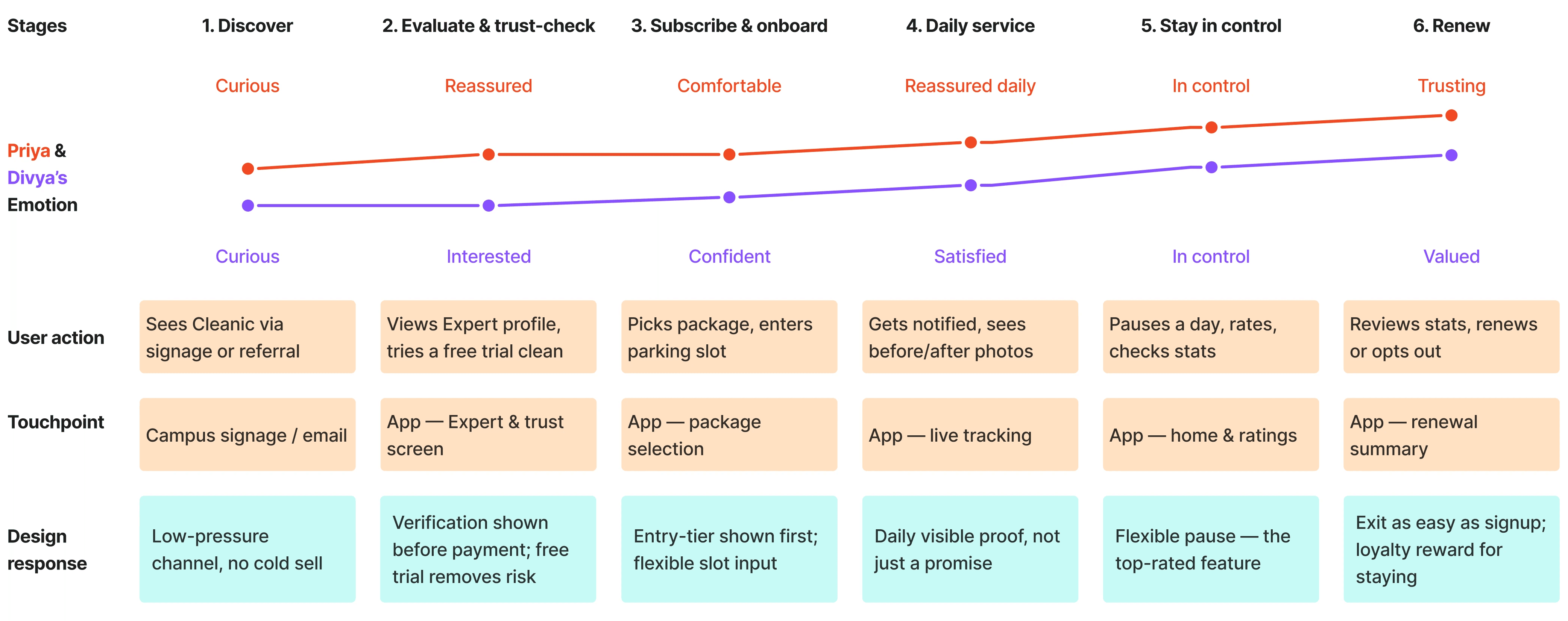
Both personas start at the same "curious" and end at the same "trusting/valued" – but Priya needs more convincing at stage 2 specifically, which is exactly why trust-sequencing was built for her barrier, not Divya's.

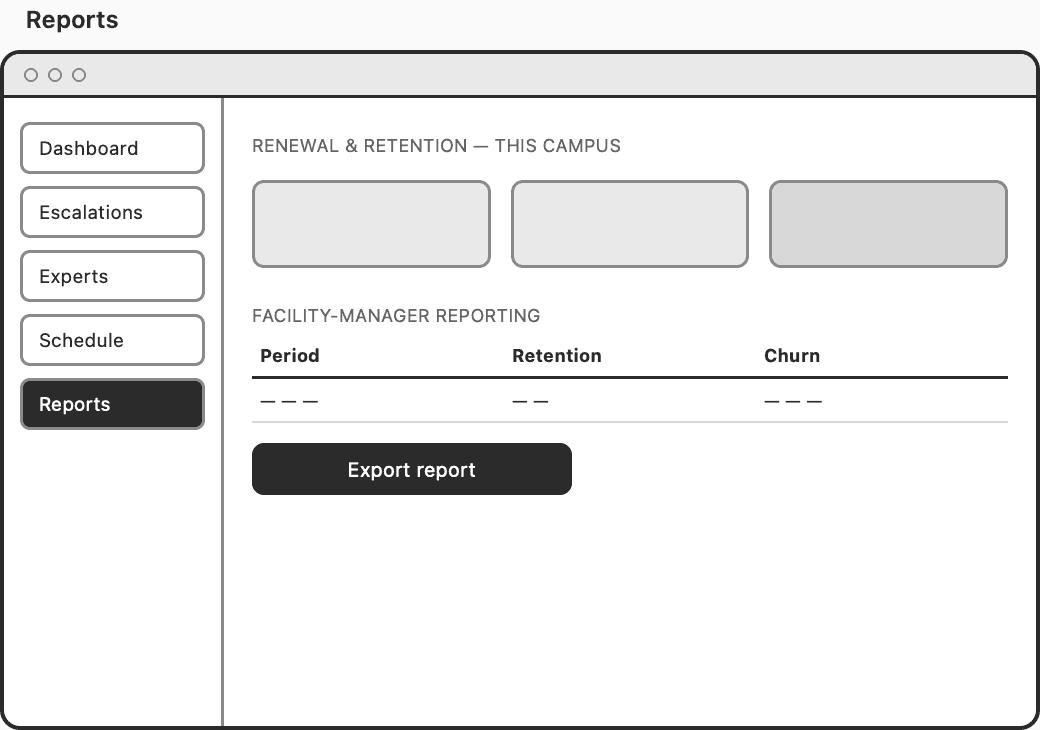
Retention data quietly serves the facility manager relationship, not just billing.
And the daily-service stage is the one moment an Expert is visible to the customer and monitored backstage by a Coordinator – the mechanism making "trust, delivered daily" enforceable.
User Flows & Structure
Three task flows – subscribe, pause a day, rate an Expert, each with a real decision point and edge case.


Sitemap – User app
Onboarding stack (pre-subscription) + main app tab structure (post-subscription)

Mapping the sitemap caught that "live tracking" and "rating" aren't standalone screens at all: one's a pushed screen, one's a modal. Neither belongs in a tab bar.
Lo-fi wireframe: User App


Expert Experience
Salaried, works a fixed zone of ~35 pre-mapped bays per shift.
A shift checklist, not a routing app.
Minimal 2-tab structure – one core loop
Vehicle-not-present + connectivity edge cases
Reuses original survey's signal-quality finding
Task flow: Expert shift checklist and connectivity edge case

The connectivity edge case reuses the original survey's signal-quality finding directly: the Expert works in exactly the underground/covered parking conditions respondents flagged, so photo upload queues and retries instead of penalizing the Expert for something outside their control.
Lo-fi wireframe: Expert App


Sitemap: Expert app
Deliberately minimal – one core loop (the shift checklist), everything else secondary

Coordinator Experience
The plan explicitly calls this a "dashboard" – desk-based monitor-and-triage, a different context entirely.
5-section sidebar – built for scanning many cases
Escalation queue: shared by 2 different triggers
Proves the blueprint works as one connected system
Task flow: Assignment to a route

Task flow: Handle an escalation

Task flow: Flag a low-rated Expert

The escalation queue has two entry points already built elsewhere in this project – (1) The user's late-skip edge case, and (2) The Expert's "vehicle not present" flag, is a proof the blueprint's backstage layer is one connected system.
Sitemap: Coordinator portal
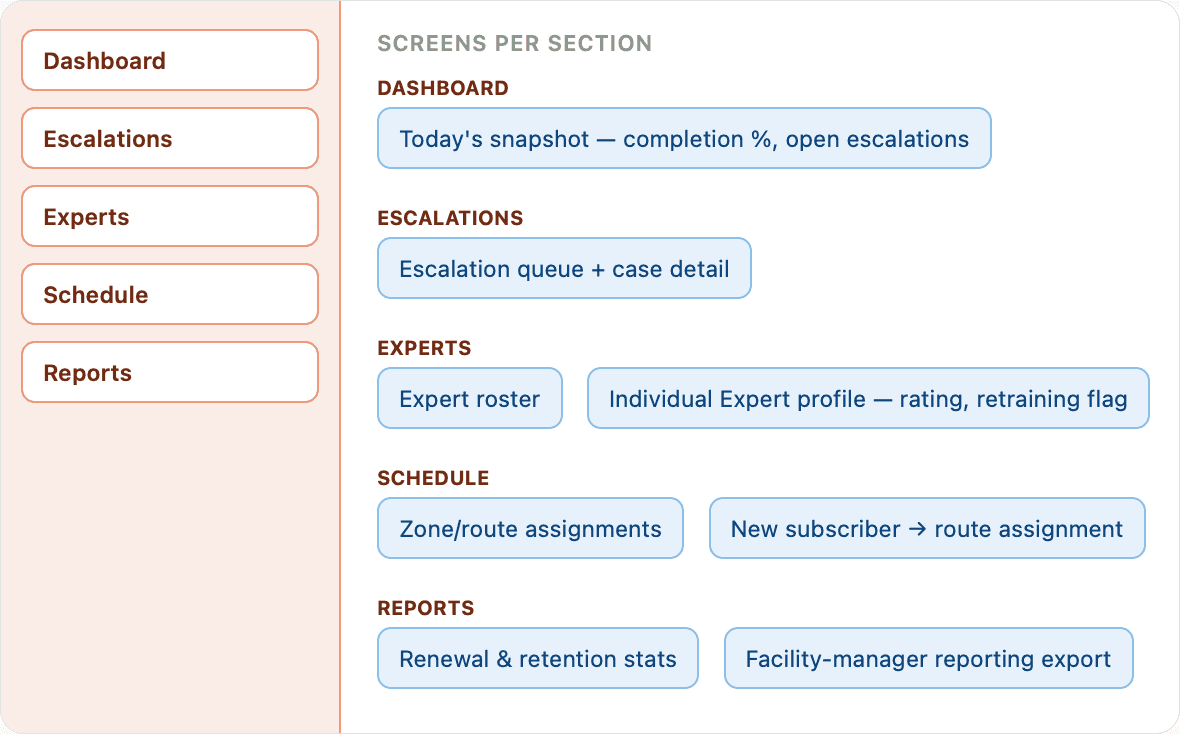
Lo-fi wireframe: Coordinator portal


Reflection
This project stops short of a real product decision – Cleanic hasn't launched, so there's no adoption or retention number to report, and I'd rather say that plainly than manufacture one.
What I'd validate next:
Whether trust-sequencing measurably improves signup completion for the Skeptical Loyalist segment specifically.
Whether the slot-number input resolves the fixed-parking-zone conflict in practice, or introduces new friction.
A second, wider survey round – deliberately outside any personal or residential network.